

March 23, 2026

Inside the World of Intimacy Coordination
Wuthering Heights © Warner Bros.
Intimacy Professionals are having a moment.
Recently, media outlets The Guardian and Vanity Fair published back-to-back articles on Intimacy Coordinators, drawing attention to the role, and recent experiences involving some high-profile performers and their work with ‘ICs’. There’s no question that there’s a growing fascination with Intimacy based roles in the Film & TV industry, and why they matter. And with recent hits like Hamnet, Wuthering Heights and Adolescence all bringing qualified Intimacy Coordinators on board, it’s no wonder they’re in the spotlight.
Quick whistle-stop tour: the need for better practices and protocols around ‘intimate’ scenes has always existed. However, the conversation gained real momentum in the mid-2010s, largely driven by the #MeToo movement and increased media scrutiny of harassment within the entertainment industry. It wasn’t until 2017 that the role of the Intimacy Coordinator received its first on-screen credit (HBO’s The Deuce). Since then, the position has quickly become a mainstay. In the US, Intimacy Coordinators are now unionised through SAG-AFTRA, and in the UK, BECTU has its own registry of Intimacy Coordinators.

But as a role that supports both the creative and ethical fabric of the industry, what does Intimacy Coordination actually look like in practice? How is the profession evolving, and what should aspiring Intimacy Coordinators keep in mind as they build their careers?
To provide deeper insight, I spoke with several intimacy professionals, who offered candid insights into what the role truly involves – and why the commonly used shorthand description, ‘the stunt coordinators of sex,’ doesn’t tell the whole story.
“You have to think broadly and creatively problem solve” says Robbie Taylor Hunt (Pillion, 28 Years Later: The Bone Temple), who agrees there’s a synergy between the artistic and safeguarding elements of the role. “The consent side is always there, baked into everything. However, if that’s been done well during prep, then it can become much more about the choreography and the creative side.” As Robbie explains, much of the work happens long before an Intimacy Coordinator ever steps onto set. Ideally, ICs are (or should be) brought onto a production around the same time as other HODs. That early involvement then gives them the chance to properly dig into the script and understand its creative intent. From there, they can flag scenes involving nudity, simulated sex, or other forms of intimacy, and start thinking through how those moments might be approached safely and collaboratively.
That prep stage usually involves one-to-one conversations with actors, discussing boundaries, expectations, and any concerns ahead of filming. Performers may also sign intimacy or nudity riders, clearly outlining what has been agreed on screen. ICs will also liaise with the ADs to make sure practical measures – like closed-set protocols – are in place when those scenes are filmed. On larger productions, there may even be dedicated rehearsal time, allowing intimate moments to be choreographed before the cameras roll.

But even with that groundwork in place, the reality on set can still vary widely from production to production.
“All productions work differently” echoes Miriam Lucia, who says a Producers’ attitude and feelings towards ICs can often shape the entire experience. To some, ICs are still viewed as something akin to the ‘sex police’ – a box-ticking exercise, whilst others are genuinely interested in opening up conversations about what good intimacy looks like. Miriam, who has coordinated two of this year’s biggest successes, Wuthering Heights and Hamnet, states that monitoring on-set dynamics and simply being able to read a room, is one of the most essential skills an IC can have. “An actor’s attitude can shift and slip from comfortable to uncomfortable very quickly – as an IC, you need to be able to spot that and act accordingly.” It’s a point Robbie also returns to: “If there’s a boundary change or withdrawal of consent, you need to be able to adapt creatively to still tell the story within those new boundaries.”
That attentiveness goes both ways. When talking about intimacy in broader terms – sexual or otherwise – Miriam also stresses that it’s vital for an IC to understand and recognise their own boundaries. “You may be working on a scene that is violent or traumatic in nature and knowing you can handle that ensures you’re doing the job well.” Equally, Miriam emphasises the importance of others understanding the IC’s boundaries, too. “I’m not a therapist or a counsellor – that isn’t part of the job. There are other trained professionals on set who can provide that support.”

That mindfulness extends to the day-to-day realities on set. As Miriam points out, no two days on set are ever the same – Intimacy Coordination is rarely a one-size-fits-all process. Each production, performer, and scene brings its own dynamics, meaning ICs are constantly adapting their approach in real time. And part of that adaptation can involve managing pushback. Whilst many actors welcome the collaboration, some are still adjusting. As Robbie explains:
“I’ve had situations where an actor says to me very respectfully: I feel completely fine about this intimate content, I’m very happy working with the Director and trust my co-star completely. To me, that is totally understandable. If all parties feel the same, then I don’t need to work on the choreography part of the scene. However, I do need to have had a brief conversation with the performers beforehand, so I know they’re comfortable.”
And ICs aren’t just there for the actors. The crew benefits too – anyone working around sensitive material can rely on them to keep things clear and respectful. Even actors who feel completely comfortable need IC support in a different way: their scene partner’s boundaries still matter, and the IC is there to make sure everyone’s consent is honoured. And it’s not just sexual scenes where ICs play a role. They also support performers through moments that can feel vulnerable or exposed. That could be anything from childbirth to a bathing scene – or other intimate actions that leave actors in sensitive positions, or require full or partial nudity. When underage performers are involved, safeguarding becomes even more important. ICs work closely with the performer’s Chaperone to make sure the right protocols are in place, whilst keeping true to the story. It’s a good reminder that Intimacy Coordinators aren’t there to hinder creativity – they’re there to help it happen safely.
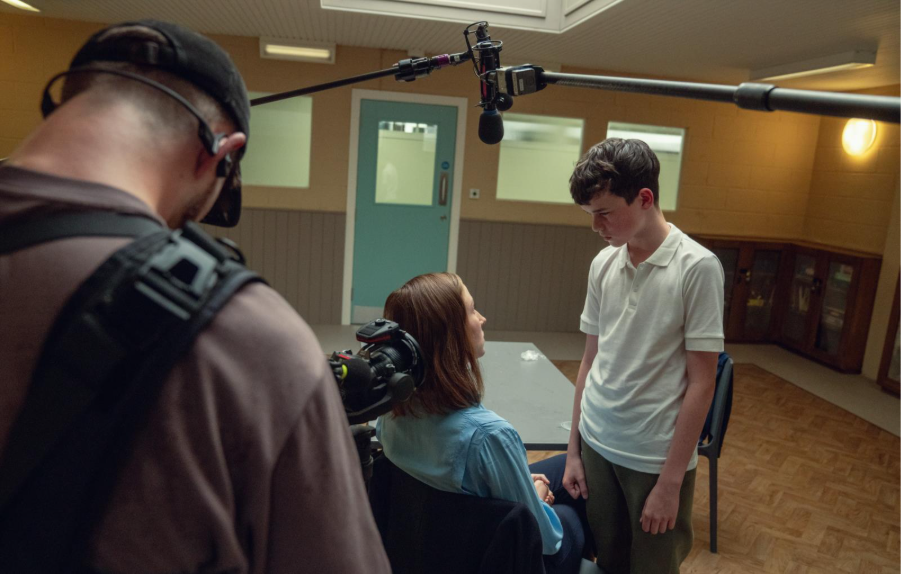
But beyond logistics and safeguarding, their proximity to the work also means ICs can influence how intimacy – and relationships – are represented on screen. They play an integral role in helping shape the authenticity of what audiences see – particularly in stories involving LGBTQIA+ relationships.
For many ICs, supporting authentic and respectful LGBTQIA+ representation is an increasingly important part of the work. By creating a structured space to discuss boundaries, body language, and character intention, they can help ensure intimate moments feel grounded in the story rather than relying on outdated stereotypes or assumptions. “Queer sex on screen has not been as diverse or representative as straight sex”, explains Robbie, “so even with the best will in the world, filmmakers are often coming from a skewed perspective.”
However, whilst ICs can help challenge well-worn tropes and support more nuanced portrayals of queer intimacy, it’s important to remember they don’t have creative oversight. They can’t overrule a Director’s vision, and they’re not there to direct the actors. Instead, their role is collaborative: facilitating conversations, helping choreograph moments when needed, and ensuring performers feel safe and informed. And in doing so, they help create the conditions for more authentic storytelling – without ever taking creative control away from the filmmakers. “ICs are trained to be prepared on authentic choreography that speaks to the wide range of sex that LGBTQIA+ people can have”, says Robbie.

Miriam also spoke about the importance of choice. For some performers, working with an IC who understands or advocates for their rights and experiences can make a real difference. Others may simply feel more comfortable working with a Coordinator of a particular gender. Wherever possible, offering that choice helps create a more trusting and supportive environment on set.
So, what does it take to become an IC? “My brilliant colleague Adelaide Waldrop says her most valuable experience was being a waiter – an intense environment, juggling people and staying calm when the kitchen’s on fire. It feels pretty apt,” says Robbie. In practice, ICs come from all kinds of backgrounds: acting, law, HR, workshop facilitators, or as dancers, movement coaches, and choreographers. The role demands a mix of artistic awareness, technical know-how, and ethical professionalism.
Certain traits consistently stand out among successful ICs:
- Empathy and Sensitivity: Understanding and responding to performers’ emotional needs.
- Communication: Clearly and confidently engaging everyone on set, from Directors to Actors.
- Advocacy and Diplomacy: Standing up for Actors’ wellbeing whilst respecting the production’s direction.
- Detail-Oriented and Creative: Spotting subtle nuances and solving complex challenges.
- Discretion and Professionalism: Handling sensitive situations with tact and composure.
For anyone wanting to work in film and TV, Intimacy Coordination might not be a role you’d initially consider – but for those with the right skillset, it can be a natural transition.
Looking ahead, both Miriam and Robbie agree the role should become so standardised that it feels almost invisible to the point of mundane. “Honestly, I hope productions don’t even ask whether performers want an IC – they just hire one,” says Robbie. “We aren’t here to be a nuisance; we just want everything done safely and professionally.”
With thanks to Miriam Lucia and Robbie Taylor Hunt for their insights and contributions to this article.
Qualified Intimacy Coordinators are encouraged to register on Filming in England’s National Crew Directory here. Take a closer look at other less obvious roles shaping the industry in our Hidden Careers blog here.
Visit the BECTU Intimacy Coordinator branch here.